
September 22, 2026
What Size Dumpster Do I Need?
Straight answers from your local, family-owned dumpster crew — call us at (480) 292-2924 anytime.
Author

Most people picking a dumpster size think about one thing: how much stuff do I have? That's half the question. The other half — how much all of that stuff weighs once it's loaded in — is the one that actually trips people up.
Every DumpStar dumpster comes with included weight built into the price. Go over it, and you're paying by the ton for the extra. So the real question isn't just "will it fit," it's "will I run out of room first, or run out of weight first?" Those are two different projects, and they don't always need the size you'd guess.
Quick Reference: What Each Size Holds
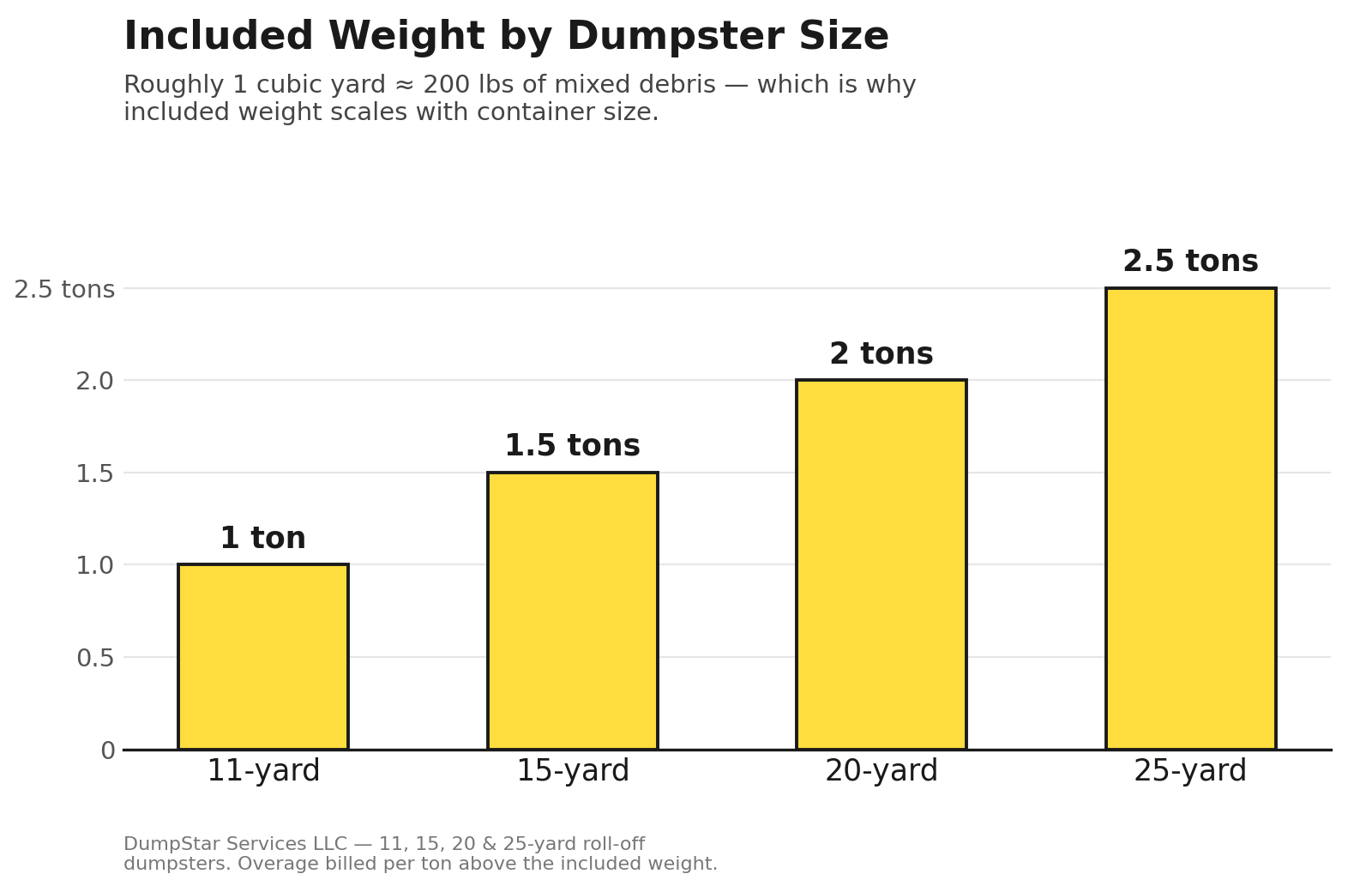
| Size | Included Weight | Best For |
|---|---|---|
| 11-yard | 1 ton | Dense and heavy debris in a small footprint — tile tear-outs, single-room remodels, bathroom gut jobs. Also a good fit for routine yearly junk removal with limited bulky items. |
| 15-yard | 1.5 tons | Small-to-medium cleanouts, kitchen remodels, moderate renovation debris |
| 20-yard | 2 tons | General household cleanouts, garage cleanouts, mid-size remodels |
| 25-yard | 2.5 tons | Move-outs, estate cleanouts, and projects with a lot of bulky furniture or appliances |
If it helps to picture it in more everyday terms, here's roughly how each size compares to things you already have a feel for — a 96-gallon weekly trash can, a 33-gallon trash bag, and a level pickup truck bed load (loaded to the rails, not heaped, and given as a range since a short-bed truck and a long-bed truck hold noticeably different amounts):
| Size | ~96-gal Trash Cans | ~33-gal Trash Bags | ~Pickup Bed Loads |
|---|---|---|---|
| 11-yard | 20-25 | 65-70 | 5-7 |
| 15-yard | 30-35 | 90-95 | |
| 20-yard | 40-45 | 120-125 | 9-13 |
| 25-yard | 50-55 | 150-155 | 11-16 |
These are volume comparisons, not exact loading guarantees — real capacity depends on can size, how things pack, and which size truck you're picturing. But they're a useful gut check if cubic yards don't mean much to you on their own.
Room vs. weight — the distinction that actually matters
Here's a rule of thumb that holds up well for average mixed debris: roughly 1 cubic yard of material weighs about 200 pounds. That's actually why the included weight climbs the way it does as the dumpsters get bigger — an 11-yard container is rated for 1 ton, a 25-yard for 2.5 tons, scaling right along with the size.
But "average" is doing a lot of work in that sentence, because not everything weighs the same for the space it takes up. That's the part a lot of size guides skip.
If you're decluttering, it's almost always about room, not weight
A dresser, a set of cabinets, a sofa, a washer or dryer — all of that is bulky, but it's mostly hollow. It eats up space fast without weighing much. If you're doing a typical household cleanout — garage, closets, general junk — you'll almost always run out of room before you get anywhere near the weight limit. The deciding factor here is really just: how much stuff do you have?
If you're doing remodel work, weight sneaks up on you
Tile is the classic example. It doesn't take up much room, but it adds up in weight fast — often before the dumpster even looks close to full. A full bathroom remodel (vanity, toilet, tile, fixtures) is a great example of a project that fits comfortably in an 11-yard dumpster, not because there isn't much volume, but because the included weight is what you're actually working with. If your project involves tile, roofing, drywall in any real quantity, or other dense material, size up for weight, not for looks — the dumpster might still look half-empty when it's at its limit.
Moving out? Go a size up if you're on the fence
This is one of the clearest patterns we see: more than half of people moving out end up wishing they'd gone bigger, or ordering a second dumpster. It's a deadline problem — when you're moving, the house has to be empty by a certain date, and people almost always find more to get rid of than they expected once they're digging through closets, attics, and under the bed.
Compare that to a spring-cleaning-type project, where there's no hard deadline. If you fill it up, you can just hold onto the rest for next time, or work it into your regular trash pickup. Movers don't have that option — so if you're between two sizes and you're moving, take the bigger one.
A trick worth knowing if you're trying to stay in a smaller size
Some contractors deliberately order a smaller dumpster and then break everything down — demoing cabinets, cutting up furniture, flattening what they can — to cut out the wasted air space. If you've got bulky-but-light items and you're trying to make a smaller (and cheaper) dumpster work, breaking things down before they go in is the way to do it.
The height difference matters for heavy lifting too
There's a lifting consideration that doesn't get talked about much: the 11-yard and 15-yard dumpsters are 4 feet tall, which makes it noticeably easier to lift heavy items in once the back door is closed. The 20-yard steps up to 5 feet, and the 25-yard is 6 feet — both still very manageable, but heavy items take a bit more effort to lift over the side once the door's shut. If you're moving a lot of dense, heavy material by hand, that's worth factoring in alongside the included weight itself.
Still not sure? Here's how we'd talk it through
When someone calls unsure which size to get, the first thing we ask is what kind of stuff they're dealing with. That one question usually settles it: mostly bulky household items with nothing especially heavy? You're room-limited — go with how much stuff you actually have. Mostly dense material like tile, roofing, or drywall in bulk, even if it doesn't look like much? You're weight-limited, and a smaller size might genuinely be the right call.
If you're still not sure after that, give us a call at 480-292-2924 and walk us through the project — we'll help you land on the right size before you book.
FAQ
Depends on why you'd be sizing up. If your project is room-limited — a big household cleanout, lots of bulky-but-light stuff — sizing up genuinely buys you more usable space. If it's weight-limited — tile, roofing, other dense material — sizing up still helps, just differently: a bigger dumpster comes with more included weight built into the price, so you're effectively pre-paying for more tonnage upfront. Going with a smaller size is still a perfectly good option if you're not sure — you'll just want to be ready for the overage if the project turns out heavier than that size's included weight, which is billed on a prorated basis, not as a flat penalty. Describe the project and we can help you figure out which approach fits.
Ask yourself what you're actually getting rid of. Bulky-but-light stuff — furniture, boxes, general household junk — is a room question. Dense material — tile, roofing, drywall in quantity — is a weight question, even if it doesn't look like much. Still not sure? Call us at 480-292-2924 and tell us what's going in, and we'll help you land on the right size.
We offer a 30-day return policy on all items. Contact our support team and we'll guide you through the process.
You can reach our support team via email, phone, or through the contact form on our website. We're here to help!
Yes! We regularly offer promotions and discounts. Sign up for our newsletter to stay updated on the latest deals.
Absolutely! We offer a free 14-day trial with no credit card required. Try it out and see if it's the right fit for you.
We accept all major credit cards, PayPal, and bank transfers. All transactions are secure and encrypted.
Yes, you can cancel your subscription at any time with no hidden fees. Your access continues until the end of the billing period.
